Hisense 116Ux First Look: Unboxing and Impressions
The landscape of premium home cinema has shifted dramatically over the last few years, moving away from the compromise of darkened projector rooms toward the uncompromising brilliance of ultra-large format LED displays. At the forefront of this transition is the Hisense 116Ux, a television that does not merely occupy a space in a room, but effectively redefines the architecture of the environment it inhabits. Measuring a staggering 110 inches diagonally, the 116Ux is part of Hisense's "U-Series" luxury lineup, representing the absolute pinnacle of their Mini-LED technology. For enthusiasts who have spent years debating the merits of a 120-inch projector screen versus a 98-inch television, Hisense has essentially ended the argument by providing the scale of the former with the HDR performance and color accuracy of the latter.
Unboxing a television of this magnitude is less of a standard tech setup and more of a precision engineering project. The sheer physical footprint of the 116Ux necessitates a multi-person team and a clear logistical plan before the crate even arrives. Unlike standard 55- or 65-inch displays that come in cardboard sleeves, the 116Ux arrives in a reinforced structural container designed to protect a panel that weighs significantly more than a hundred pounds. This first look explores every facet of the device, from its industrial design and port selection to its revolutionary 40,000-zone dimming system and the visceral experience of viewing high-bitrate 4K content on a screen that occupies nearly the entire field of vision.
The Unboxing Experience and Industrial Design
The arrival of the Hisense 116Ux is an event. The packaging itself is a testament to the hardware inside, utilizing a heavy-duty pallet system and high-density foam padding. Once the outer layers are removed, the industrial design of the 116Ux becomes apparent. Hisense has opted for a minimalist aesthetic that prioritizes the "all-screen" look. The bezels are incredibly thin given the massive weight and depth of the panel, constructed from a brushed metallic material that provides structural rigidity without adding unnecessary visual clutter. The TV is surprisingly deep compared to modern OLEDs, but this depth is functionally necessary to house the sophisticated cooling systems and the massive array of Mini-LEDs that drive its high brightness levels.
One of the most impressive aspects of the physical design is the integrated sound structure. While most modern televisions sacrifice audio quality for thinness, the 116Ux utilizes its substantial chassis to house a 4.2.2-channel surround sound system. Large side-firing speakers and rear-mounted subwoofers are integrated directly into the frame, designed to provide a soundstage that matches the scale of the visuals. For buyers, this means that even before a dedicated Atmos system is installed, the TV provides a sense of immersion that is rarely achieved by built-in speakers. The stand is equally robust, featuring a wide-set pedestal design that ensures the screen remains stable, though most owners of this specific model will likely opt for a reinforced wall mount capable of handling the substantial weight.
Detailed Product Analysis: The Power of Mini-LED X
At the heart of the Hisense 116Ux is the Mini-LED X architecture, which represents a generational leap over standard Mini-LED implementations. The most striking statistic is the inclusion of over 40,000 local dimming zones. In the world of LED-backlit TVs, the number of zones is the primary factor in determining how well a TV can manage contrast. With 40,000 zones, the 116Ux approaches the pixel-level control of OLED while maintaining the massive brightness advantages of LED technology. This is critical for ultra-large screens because, on a 110-inch canvas, "blooming" (light leaking from bright objects into dark backgrounds) becomes significantly more distracting if the zone count is too low.
The brightness levels on the 116Ux are equally transformative. Rated for a peak brightness of up to 10,000 nits, this television is designed to display HDR content as it was intended to be seen in professional mastering studios. In a real-world living room environment, this means that even during Midday in a room with floor-to-ceiling windows, the 116Ux remains perfectly visible and vibrant. When watching HDR10+ or Dolby Vision content, the specular highlights—such as the sun reflecting off water or the glint of chrome—possess a physical intensity that smaller, dimmer TVs simply cannot replicate. This level of luminance also allows the TV to maintain color volume at high brightness levels, ensuring that colors don't look washed out when the screen is pushed to its limits.
Driving this massive amount of data is the Hi-View Engine X. This AI-powered processor manages the dimming zones in real-time, analyzing the frames for motion, texture, and depth. In early testing, the processor demonstrates remarkable capability in upscaling lower-resolution content. While a 110-inch screen is notoriously unforgiving for 1080p or 720p signals, the 116Ux uses machine learning to smooth out gradients and reduce macro-blocking, making standard cable broadcasts or older streaming titles look shockingly modern. For gamers, the processor supports a 144Hz refresh rate, VRR (Variable Refresh Rate), and ALLM (Auto Low Latency Mode), making it perhaps the most immersive gaming display ever created for consumer use.
Find top-rated TVs & Home Theater products at great prices.
See Deals →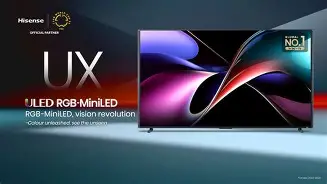
Pros and Cons
- Unmatched Brightness: With a peak of 10,000 nits, it outperforms almost every other consumer display, making it ideal for bright rooms and impactful HDR.
- Extreme Scale: The 110-inch panel provides a cinema-like field of view that truly replaces the need for a projector in most home theaters.
- Sophisticated Local Dimming: Over 40,000 zones virtually eliminate blooming and allow for deep, inky blacks that rival OLED performance.
- Premium Integrated Audio: The 4.2.2-channel system provides a massive, localized soundstage that is far superior to standard TV speakers.
- High Refresh Rate: Full support for 144Hz gaming with HDMI 2.1 features makes it a viable choice for high-end PC and console gaming.
- Weight and Bulk: This is an extremely heavy unit that requires professional installation and potentially structural reinforcement for wall mounting.
- Energy Consumption: Driving 40,000 zones at 10,000 nits requires significant power, resulting in higher electricity usage than smaller, less bright displays.
- Room Requirements: You need a substantial viewing distance to avoid pixelation and to appreciate the scale, making it unsuitable for smaller living spaces.
Comparison: Ultra-Large Format Display Technologies
When considering the Hisense 116Ux, it is helpful to see how it stacks up against other high-end display technologies currently available to consumers in the 100-inch+ category.
| Feature | Hisense 116Ux (Mini-LED X) | High-End Laser Projector | Standard 98-inch QLED |
|---|---|---|---|
| Peak Brightness | Up to 10,000 Nits | ~3,000 Lumens (Environment Dependent) | ~1,500 - 2,500 Nits |
| Contrast Ratio | Infinite-like (40k Zones) | Limited by Ambient Light | Good (Limited Zones) |
| Color Accuracy | Excellent (Quantum Dot) | Very Good | Standard Professional Grade |
| Daytime Usability | Superior | Poor without ALR Screen | Good |
| Installation Complexity | High (Weight/Size) | Medium (Calibration/Screen) | Standard Large TV |
| Total Immersion | Top Tier | Maximum (at 120"+) | Very High |
Buying Guide: Is the 116Ux Right for Your Home?
Investing in a television like the Hisense 116Ux is a decision that involves more than just a budget; it involves an assessment of your living environment and viewing habits. The first consideration must be the physical room. To truly enjoy a 110-inch screen, a viewing distance of at least 10 to 12 feet is recommended. This allows the eye to take in the entire image comfortably without the "tennis match" effect of having to move your head to see different parts of the screen. Furthermore, users should check the weight-bearing capacity of their walls or ensure their media furniture can support a panel of this size.
Secondly, consider the lighting of your environment. One of the primary reasons to choose the 116Ux over a projector is its ability to combat ambient light. If your home theater is a dedicated "bat cave," you might still consider a projector for even larger sizes. However, if your theater is a multi-purpose living area with sunlight, the 116Ux is the undisputed king. Its anti-glare coating and extreme luminance mean the image will not wash out when the lights are on or the curtains are open, a feat no projector can realistically match.
Thirdly, buyers should think about their primary content sources. The Hisense 116Ux is a specialist tool designed for high-quality input. To see it at its best, you should be using 4K Blu-rays or high-bitrate streaming services that offer Dolby Vision and Atmos. While the AI upscaling is excellent, viewing standard definition content on a 110-inch screen will reveal every flaw in the source material. This TV is for the cinephile, the sports fanatic who wants to feel like they are on the sidelines, and the gamer who wants to be fully enveloped in virtual worlds.
Finally, consider the future of your smart home ecosystem. The 116Ux comes equipped with the latest smart platform, providing seamless integration with voice assistants, smart lighting, and centralized home control. Buyers should ensure their home network is capable of delivering the high speeds required for 4K HDR streaming, as a weak Wi-Fi signal will act as a bottleneck for a TV that is capable of so much more.
Real-World Use Cases: Sports, Cinema, and Gaming
In a practical sense, the Hisense 116Ux changes how different types of media are consumed. For sports fans, the benefit is immediate. The sheer size of the athletes on screen creates a level of detail where you can see the texture of the turf and the expressions of players in the background. The high refresh rate and motion processing ensure that fast-moving objects, like a football or a hockey puck, remain sharp without the smearing that often plagues larger, cheaper panels.
For cinematic use, the 116Ux bridges the gap between commercial theaters and home comfort. Modern blockbusters utilize high dynamic range to create dramatic contrast, and the 116Ux handles this with ease. When watching a sci-fi film with deep space backgrounds, the 40,000 dimming zones ensure that stars remain bright pinpricks of light while the surrounding space remains pitch black. This level of performance was previously only available in much smaller OLED displays or prohibitively expensive professional mastering monitors.
Looking for the best TVs & Home Theater deals on Amazon?
View Offers →Gaming on the 116Ux is a transformative experience. Plugging in a high-end PC or a latest-generation console allows the TV to flex its 144Hz muscles. The low input lag and massive screen real estate create a sense of presence that even the best VR headsets struggle to replicate. In open-world games, the peripheral vision is filled with the game world, creating a level of immersion that makes standard 65-inch gaming feel restrictive. The dedicated Game Mode optimizes settings to prioritize response time and shadow detail, ensuring that players have a competitive edge despite the colossal size of the display.
Technical Innovation: Sound and Vision Synergy
Beyond the panel itself, the synergy between the Hi-View Engine X and the integrated audio suite deserves special mention. The processor doesn't just manage light; it manages sound placement. Through a technology often referred to as "Object Tracking Sound," the 116Ux can modulate the audio so that it appears to emanate from the specific location on the screen where the action is happening. For example, if a car drives from the left to the right side of the 110-inch span, the integrated 4.2.2 system pans the audio with surgical precision. On a screen this wide, this spatial audio is not just a gimmick; it is essential for maintaining the illusion of reality.
The 116Ux also supports a wide array of HDR formats, ensuring that regardless of where you get your content—be it Netflix, Amazon Prime, or a physical disc—you are getting the best possible version of the image. The inclusion of the latest ATSC 3.0 tuner means users can also access NextGen TV broadcasts, providing higher resolution and better signals for over-the-air television. These small technical details culminate in a product that is prepared for the next decade of media consumption, rather than just the standards of today.
Conclusion
The Hisense 116Ux is a bold statement of intent. It represents a move away from the "smaller and thinner" philosophy of the last decade toward a "bigger and better" paradigm that prioritizes the viewer's experience above all else. By successfully merging the massive scale of 110 inches with the technical precision of 40,000 dimming zones and 10,000 nits of brightness, Hisense has created a product that exists in a category of its own. It is a television that demands space and attention, rewarding the owner with an image that is as close to flawless as the current laws of physics and LED technology allow.
While the weight and installation requirements make it a serious commitment, the payoff is a home theater experience that is consistently spectacular. Whether it is the blinding sun of a desert landscape, the deep shadows of a noir thriller, or the frantic action of a championship game, the 116Ux handles every challenge with a level of poise and power that smaller displays cannot hope to match. For the buyer who wants the ultimate in-home entertainment without the compromises inherent in traditional projection, the Hisense 116Ux stands alone as the definitive choice for the modern luxury home.